221
Published
Issue
Section
Categories
How to Cite
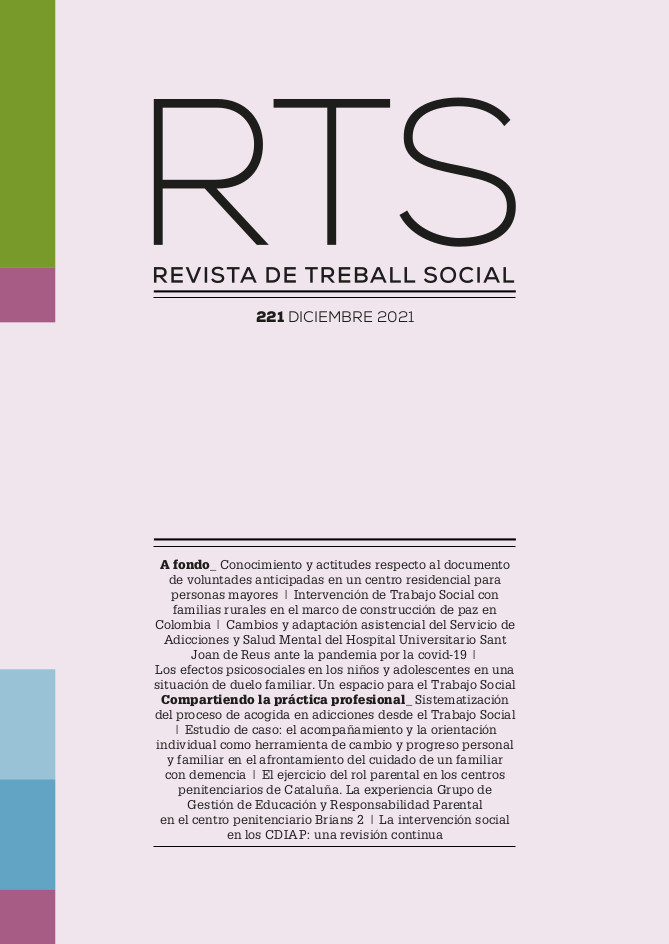
Social intervention in Early Care and Childhood Development Centres (CDIAPs): an ongoing examination
DOI:
https://doi.org/10.32061/RTS2021.221.08Abstract
There is a widespread consensus in early care about the importance of the family and the environment in childhood development and regarding the fact that promoting optimal environmental or contextual conditions improves the quality of life, and indeed the overall development of children.
The ongoing evolution that takes place in society and in the environment calls for the care provided to children and their families at Early Care and Childhood Development Centres (CDIAP) to be adapted to this constant change. For this reason, this article reviews the documents and instruments that have so far served as a guide and as guidance for the care that addresses the social and family needs exhibited by families in the context of early care. Moreover, it presents the JADE, a proposal for a flexible diagnostic tool that is easy to adapt to the unsteady nature of current realities and a model for the implementation of this tool in CDIAPs in Catalonia.
Referencias bibliográficas
Cardona, O. (2004). The need for rethinking the concepts of vulnerability and risk from a holistic perspective: a necessary review and criticism for effective risk management. En G. Bankoff (Ed.), Mapping vulnerability. Disasters, development and people, (37-52). Earthscan. Academia. Recuperado 1 mayo 2021, de https://www.academia.edu/18707404/Mapping_Vulnerability_Disasters_Development_and_People
Decreto 261/2003, de 21 de octubre, por el que se regulan los Servicios de atención precoz, DOGC núm. 4002 (2003).
Escartín, M. (1992). Manual de Trabajo Social: Modelos de pràctica profesional. Aguaclara.
Federación Estatal de Asociaciones de Profesionales de Atención Temprana y GAT. (2004). Organización Diagnóstica para la Atención Temprana: Manual de instrucciones. Real Patronato sobre Discapacidad. GAT. Recuperado 1 mayo 2021, de http://gatatenciontemprana.org/wp-content/uploads/2019/05/odat.pdf
Flament, C. (1987). Pratiques et représentations sociales. En J. Beauvois, R. Joule y J. Monteil, Perspectives cognitives et conduites sociales. Théories implicites et conflits cognitifs (p. 143-150). Delval.
García, J., González, M. D., Pola, M., y Rodríguez, A. (2014). Àmbit social de l’organització diagnòstica per a la xarxa de CDIAP de Catalunya. Unión Catalana de Centros de Atención Precoz. Recuperado 1 mayo 2021, de https://www.uccap.cat/files/glossari_09-01-2015.pdf
García, J., (2020). La construcción del diagnóstico social en atención temprana. Profesionales, intervenciones y representaciones de la familia social. Universidad Autónoma de Barcelona.
Hamilton, G. (1923) Progress in Social Case Work. Some changes in Social Case Work. National Conference on Social Welfare. Official proceedings of annual meeting. Recuperado 1 de octubre del 2019, de https://quod.lib.umich.edu/n/ncosw/ACH8650.1923.001/347?rgn=full+text;view=image
Lippmann, W. (1922). La opinión pública. Compañía General Fabril Editora.
Moscovici, S. (1961). El psicoanálisis, su imagen y su público. Huemul.
Stallings, R. (1997). Sociological theories and disaster studies. Artículo preliminar 249 de la Distinguished Lecture on Disaster and Risk en el Disaster Research Center, Departamento de Sociología y Justicia Criminal, Universidad de Delaware, Newark, 17 abril 1997. Recuperado 1 mayo 2021, de http://citeseerx.ist.psu.edu/viewdoc/download?doi=10.1.1.844.6650&rep=rep1&type=pdf
Wisner, B., Blaikie, P., Cannon, T., y Davis, I. (2004). At risk: natural hazards, people’s vulnerability and disasters. Routledge. Recuperado 1 mayo 2021, de http://www.geo.mtu.edu/volcanoes/06upgrade/Social-KateG/Attachments%20Used/AtRiskReview.pdf.pdf